

Illuminating the role of zinc in cell biology
Zinc is the second most abundant transition metal in biology and plays a crucial role in a wide variety of cellular processes. Roughly 10% of the human genome encodes for zinc-binding proteins and all cells must regulate and maintain their own pool of labile zinc. It has been shown that zinc is essential for cell growth and proliferation as a biological cofactor and as a signaling ion. It also plays a role in genome integrity, immune function, and the senses of taste and smell! Despite its critical role in cell physiology and human health, many questions remain regarding its mechanisms of action. The Palmer Lab uses novel fluorescent metal ion sensors and in vitro mammalian cell experiments to investigate zinc dynamics in different contexts. For example, we use multiple types of breast cancer cells to study the involvement of zinc in cancer and tumor growth, and primary hippocampal neurons to study the role of zinc in the brain and nervous system.

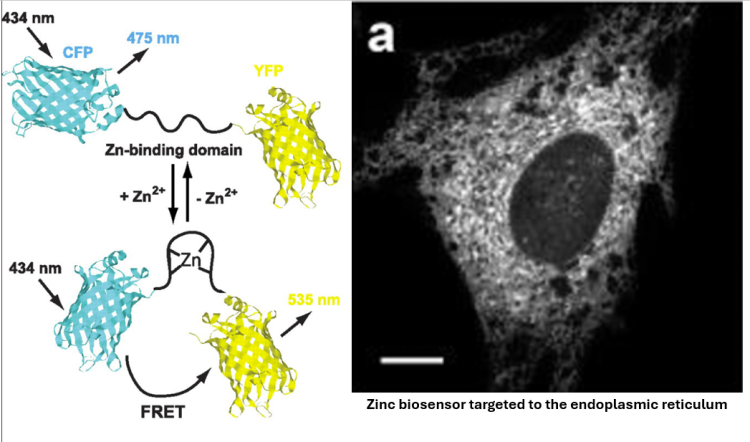
Our lab specializes in creating biosensors to quantitively study zinc. Our genetically encoded biosensors take advantage of Förster resonance energy transfer (FRET) to create a ratiometric sensor that can accurately and precisely quantify labile zinc levels. We have rigorously characterized our biosensors both in-vitro and in cells. We have targeted our zinc sensors to multiple subcellular locations, and defined a cellular map of labile zinc levels. The lab has employed our zinc sensors to study zinc signaling in many cellular contexts (see projects below). We continue to develop new zinc biosensors and use our biosensors in our research projects on zinc signaling. Below are some highlighted papers on our zinc biosensors (for a full list of our publications see the 'publications' tab.)
Early zinc sensor work Quantifying labile zinc levels High throughput in-vitro characterization Targeting subcellular locations
Zinc is critical for growth. Zinc deficiency has been shown to impair growth and cellular proliferation across multiple organisms. Palmer lab has used a combination of advanced techniques including genetically encoded fluorescent sensors, long-term live cell imaging and computational tools, to track labile zinc in asynchronously cycling cells and across cell cycle stages to infer critical knowledge on zinc’s dynamical role in cell cycle. Palmer lab discovered that mild zinc deficiency results in cellular quiescence and that a pulse of zinc is present during mitosis. If this pulse is too high or too low, cells enter quiescence. Even a short pulse of zinc deficiency can hinder DNA synthesis causing cells to accumulate DNA damage.
Human cells experience a Zn2+ pulse... Transient Zn2+ deficiency induces... Single cell analysis reveals...

Zinc concentrations have been shown to be elevated in breast cancer tumors and changes in zinc transporter expression correlate to tumor aggressiveness in patients. This project, whose primary contributors are Palmer Lab undergraduate students, seeks to characterize zinc’s effects within breast cancer cells. Previous work used fluorescence microscopy “Live-Dead Assays” (example image below) to quantify cell death under varying zinc media conditions. These data informed current studies of zinc regulatory proteins, which could help explain differences in cell viability. Additionally, zinc directly impacts caspase activation, thus the lab is also studying apoptosis as a possible pathway of cell death.

We are interested in how zinc affects the chromatin landscape and its resulting downstream effects. To address this, we employ a variety of techniques including high-throughput sequencing, proteomics, and super-resolution microscopy.
Cellular zinc status alters chromatin accessibility and binding of p53 to DNA